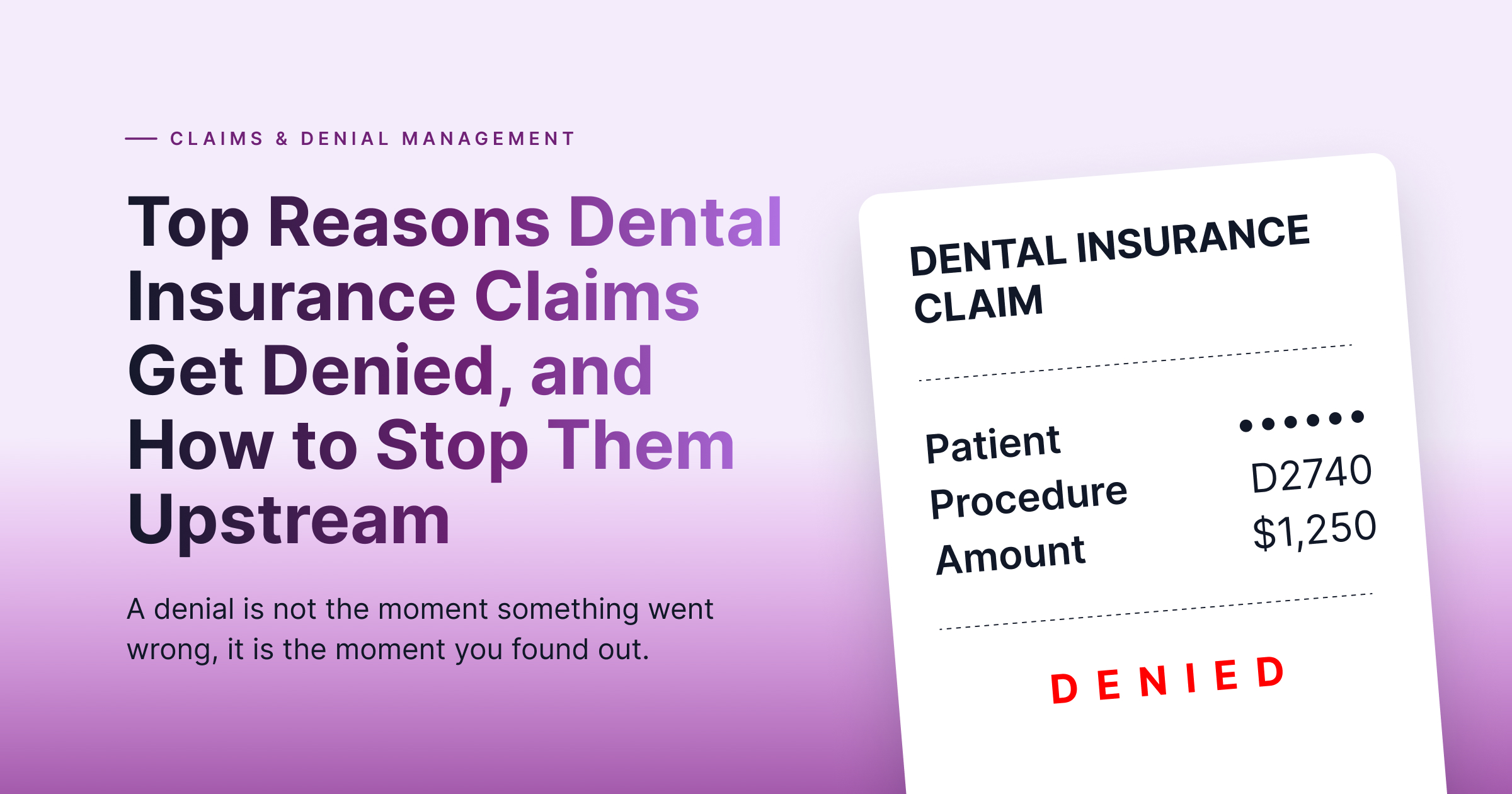
A denial is not the moment something went wrong, it is the moment you found out. By the time a payer denies a dental claim, the error that caused it usually happened weeks earlier: at booking, at the front desk, in the operatory, or in the claim itself before it ever left the building.
That is good news, because it means denials are not payer randomness. Best-performing dental teams hold their denial rate under 5%, while many practices and DSOs run at 8 to 12% or higher. The difference between these dental teams is a short list of preventable causes repeating, unnoticed, month after month. This post names the top reasons dental claims get denied, shows where each one starts, and covers how to stop them upstream instead of appealing them downstream.
Rejections vs denials
A rejected claim never made it to adjudication. It bounced at the clearinghouse or the payer’s front end, usually for a data or format error, and it can be corrected and resubmitted quickly. A denied claim however was received, adjudicated, and refused payment. Denials carry a reason code, often require an appeal, and always run against a clock, because every payer sets a window for corrections and appeals.
The distinction matters for two reasons. First, teams that lump the two together cannot see their real patterns, and the fixes are different. Second, rejections that get quietly fixed and resubmitted without being tracked hide your true first-pass performance, which is why we recommend measuring both alongside your clean claim rate.
The top reasons dental claims get denied
Every billing team’s mix looks a little different by payer and specialty, but the same causes show up at or near the top of almost every denial report.
1. Eligibility and coverage issues. The patient’s coverage was inactive, the service was not covered under the plan, a waiting period applied, or the annual maximum was already exhausted. This is the most preventable category on the list, because every one of those facts was knowable before the patient sat down.
2. Frequency limitations and plan rules. Two cleanings per year, bitewings at set intervals, replacement clauses on crowns and prosthetics. Claims filed against an exhausted frequency are adjudicated quickly and denied cleanly, and they are among the most frustrating because the payer is simply enforcing the plan.
3. Inaccurate patient or subscriber information. A transposed member ID, a wrong date of birth, the patient listed as the subscriber when they are a dependent. Most of these bounce as rejections, but the ones that slip through come back as denials weeks later, with the same tiny root cause.
4. Missing documentation and attachments. X-rays, perio charting, and narratives for procedures like scaling and root planing, crowns, and buildups. Requirements vary by payer, which is why this category persists: a claim that is complete for one payer is missing an attachment for another.
5. Coding errors, bundling, and downcoding. An outdated or incorrect CDT code, procedures the payer bundles together, or a submission the payer downcodes because the documentation did not support the code billed. These denials are also where revenue is most often lost quietly, because a downcode that nobody contests becomes the new normal.
6. Coordination of benefits. The patient has dual coverage and the payer on file is not primary, or the payer is waiting on updated COB information from the subscriber. These claims sit in limbo, and they age while they wait.
7. Timely filing. The claim, the corrected claim, or the appeal missed the payer’s submission window. Timely filing denials are the most expensive kind, because they are usually final: the work was done, and the revenue is simply gone.
8. Duplicate claims. A resubmission that was not flagged as a corrected claim reads to the payer as a duplicate and gets denied automatically, muddying your AR and inflating your denial count with self-inflicted entries.
How to stop denials upstream
Read back through that list and notice the pattern: almost nothing on it happens at the payer. The causes live at booking, at the front desk, in documentation, and in the claim scrub, which means the fixes do too.
Verify eligibility and plan details before the visit. Active coverage, frequencies, waiting periods, remaining maximums, and COB status, confirmed before the patient is in the chair. This single habit addresses the two largest categories on the list.
Capture and confirm patient data at booking. Member IDs, dates of birth, subscriber relationships, and current employer coverage, verified once at intake instead of corrected across five bounced claims.
Document and code the same day. Complete clinical notes and current CDT codes, recorded while the detail is fresh. This is what defends you against downcoding and supplies the narrative the payer will eventually ask for anyway.
Scrub every claim against payer-specific rules. Attachments, narratives, and tooth and surface detail checked against the requirements of the payer that will actually adjudicate the claim, before submission rather than after the denial.
Track denial reasons by payer and location, and feed them back. This is the lever that separates teams that fix denials from teams that fix the same denial forever. Reasons cluster. One payer, one attachment rule, one office. Reviewing the clusters monthly and correcting them at intake is how a denial rate falls and stays down.
Work whatever slips through inside the window. Prevention will not catch everything. What matters for the remainder is speed: knowing a claim was denied within days, not weeks, and getting the correction or appeal out while the window is open. If your team is discovering denials at day 120 for payers with 90-day appeal windows, the outcome was decided before anyone touched the claim.
If these fixes sound like the front half of a well-run revenue cycle, that is exactly what they are. Our 12-step dental RCM checklist covers the full sequence they belong to.
Denial reasons at a glance
What unworked denials actually cost
A denial costs you three times. It costs labor, because someone has to research the reason, gather what is missing, and resubmit or appeal. It costs speed, because a denied claim adds weeks between treatment and payment, which is one of the quiet forces behind a rising days in AR number. And when a denial is not worked in time, it costs the full amount, because a claim that ages past its appeal or filing window becomes a write-off for care your clinicians already delivered.
That is why the two halves of this post belong together. Prevention shrinks the pile, and fast, prioritized follow-up makes sure the pile that remains gets worked while it can still be won.
How InsideDesk helps: prevent the next denial, not just work this one
InsideIQ gives billing leaders the pattern view: denial trends broken out by payer, location, and reason, with benchmarking against 1,200+ supported DSOs. That is what turns “denials are up this quarter” into “this payer, this attachment rule, these two offices,” which is a problem your team can fix at intake this week.
InsideAssist handles the claims that still slip through, surfacing every denial with a live status and a next best action, and keeping work prioritized by dollars and deadline so corrections and appeals go out inside the window. Together, fewer denials happen, and the ones that do get worked while they are still winnable.
Dental claim denial FAQ
What are the most common reasons dental claims are denied?
Eligibility and coverage issues, frequency limitations, inaccurate patient or subscriber information, missing attachments or narratives, coding errors and downcoding, coordination of benefits problems, timely filing, and duplicate submissions. The mix varies by payer, but these categories dominate most denial reports.
What is the difference between a rejected and a denied dental claim?
A rejection bounces before adjudication, usually for a data or format error, and can be corrected and resubmitted quickly. A denial was adjudicated and refused payment, carries a reason code, and typically requires a corrected claim or a formal appeal within the payer’s window.
What is a good denial rate for a dental practice or DSO?
Under 5%. Many practices and DSOs run at 8 to 12% or higher, and a sustained rate above that range usually points to a repeating, fixable cause at the front of the cycle rather than payer behavior.
Can denied dental claims be appealed?
Yes. Most denials can be corrected and resubmitted or formally appealed, but every payer sets its own deadline, and many denials become permanent simply because they were discovered or worked too late. Speed of discovery matters as much as the strength of the appeal.
How do you reduce claim denials across a DSO?
Standardize the front end at every location: eligibility before the visit, confirmed intake data, same-day documentation, and payer-specific claim scrubbing. Then track denial reasons by payer and location, and fix the recurring clusters at the source. At scale, visibility is the difference, because a cause that repeats at three offices is invisible in a blended number.
The cheapest denial is the one that never happens
Denials feel like a back-office problem, but they are made at the front of the cycle and merely discovered at the back. The teams that run under 5% are not luckier with payers, and they are not better at appeals. They verify before the visit, document the same day, scrub against payer rules, and treat every denial reason as a lesson their intake process gets to learn once instead of a task their billing team repeats forever.
Want to see your denials broken out by payer, reason, and location, with the recurring patterns made obvious? See InsideDesk in action.