What Manual EOB Retrieval is Actually Costing Your DSO
If your revenue cycle management (RCM) team starts the day the way most do, it probably looks something like this.
Someone pulls up a list of recent electronic funds transfer (EFT) deposits, opens the first payer portal, navigates to the payments section, downloads the relevant explanation of benefits (EOB) document, then moves on to do the exact same thing for the next payer. Then the one after that. It is repetitive and time consuming work.
If you have never sat down to calculate what it is actually costing your organization, the number may surprise you.
InsideDesk recently announced InsideRemit, a payment posting automation solution built specifically to address this challenge. But before diving into what a better approach looks like, it is worth understanding the full scope of what manual EOB retrieval is actually costing your organization.
The True Cost of Manual EOB Retrieval
When an EFT payment lands in a bank account, it arrives without any context. There is no attachment explaining which patients it covers, which claims were approved, or how adjustments were applied. That information lives in the EOB, and the only way to get it is to go find it.
For your posting team, that means logging into one payer portal, navigating to the payments section, searching for the relevant remittance document, downloading it, then moving on to the next payer and doing it all over again. Across your locations and insurance relationships, this process can consume several hours of your team's day - and at a DSO, those hours multiply with every office you add.
The work itself is necessary. The manual execution is not. Every hour your team spends on EOB retrieval is an hour not spent resolving denials, correcting posting errors, or managing aging accounts receivable (AR). In an industry where every day of delay in posting has a direct impact on cash flow, this is not a minor inefficiency.
Where EOB Retrieval Costs Really Add Up
The cost of manual EOB retrieval goes well beyond staff time. Here is where it shows up across your DSO:
Delayed collections
When posting is behind, so is everything that depends on it. Claim reconciliation cannot be completed, secondary billing gets delayed, and patient balances sit unresolved. The longer this chain stretches, the harder collections become.
Posting errors
Manual processes introduce human error. When team members are toggling between portals, spreadsheets, and practice management systems (PMS), mistakes happen. A mismatched deposit or an incorrectly posted adjustment can create downstream reporting inconsistencies and compliance exposure.
Missed service level agreement (SLA) targets
Most DSOs hold their posting teams to internal deadlines, commonly requiring payments to be posted within three days of receipt.
When EOB retrieval alone takes hours, hitting those targets consistently becomes increasingly difficult as the organization grows.
For a DSO simultaneously, even a short delay in one location can create a ripple effect across your entire posting operation.
Staff burnout and turnover
Repetitive, high volume work with little room for error creates a difficult environment to sustain.
Posting staff who spend the bulk of their day on portal navigation are more prone to burnout, and turnover in these roles means constant retraining and disruption. This is especially costly at DSOs where a single posting team is often responsible for supporting multiple offices at once.
The Scale Problem
All of these costs are manageable at a single location. They become a serious operational problem at scale. If your DSO spans 50 locations.
For example, you may be working with 30 or more different insurance payers. Each one has its own portal, its own login credentials, its own navigation structure, and its own format for presenting remittance data. There is no standardization across payers, and there is no shortcut built into the current system.
As a revenue cycle management leader, you may find yourself without a clear, real time picture of where your team stands on any given day. If you are relying on spreadsheets and manual status updates to understand whether service level agreement (SLA) targets are being met, you are already a step behind. By the time a problem surfaces in a report, your posting team has fallen behind, and catching up means overtime or accepted delays.
A Better Approach to EOB Retrieval for DSOs
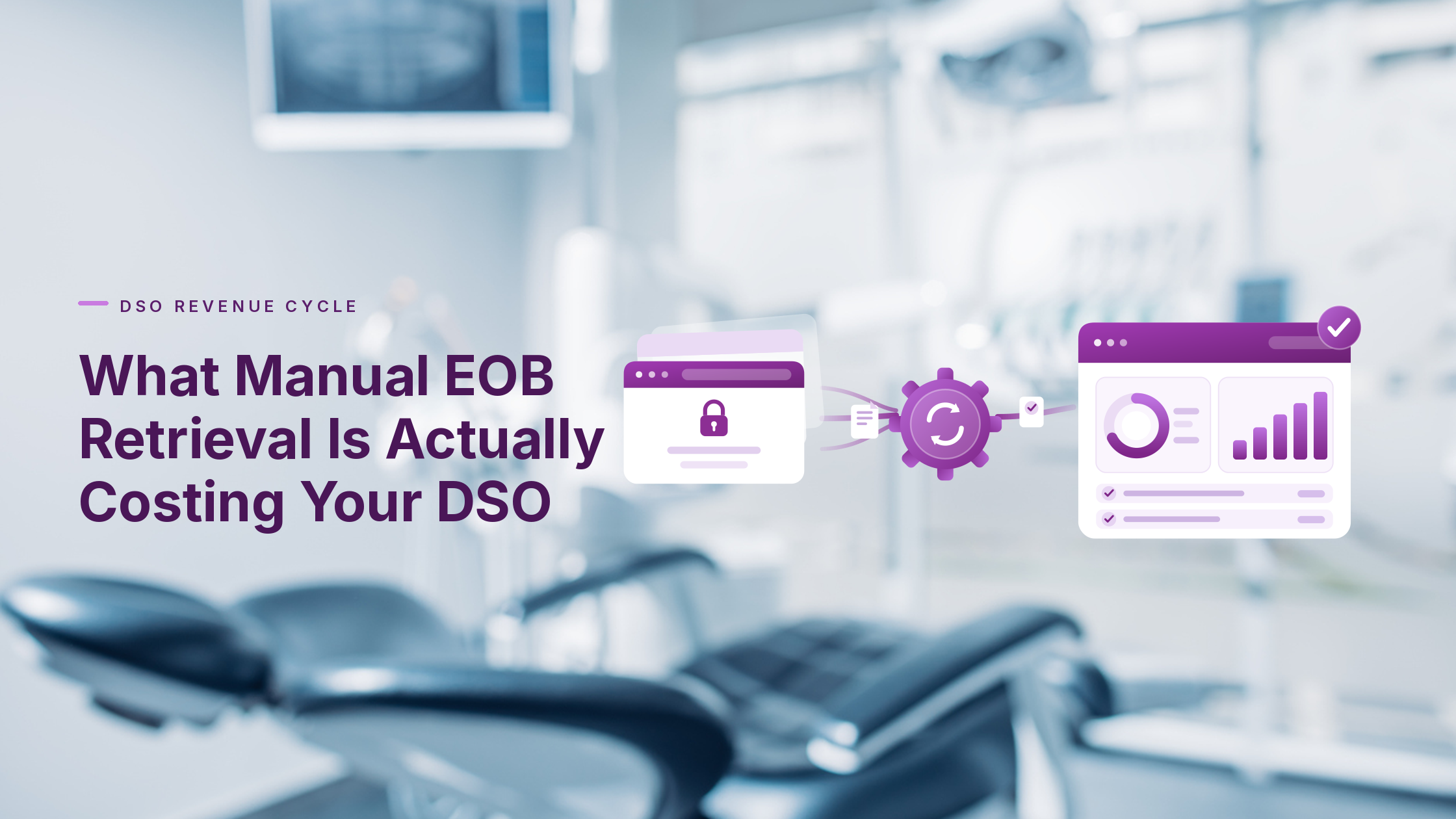
The launch of InsideRemit represents a direct response to this challenge. Rather than requiring your posting staff to log into individual payer portals one by one, InsideRemit automates the bulk collection of EOB and explanation of payment (EOP) documents. It then uses intelligent matching to connect those remittances to the corresponding EFT deposits, so your team is not spending the day on reconciliation work that can be handled automatically.
The result is a single, unified workspace where your posting team can see exactly what needs to be done, and where you can monitor performance in real time through key performance indicator (KPI) dashboards, SLA tracking, and audit trails. It works the same way across all of your locations, which addresses one of the most persistent pain points as your DSO grows: fragmented workflows that differ from office to office.
InsideRemit is part of the InsideDesk platform, which also includes InsideAssist for AR follow up, InsideDial for automated payer calls, and InsideIQ for revenue cycle analytics. The goal across all of these solutions is the same: give your team back the time they are currently losing to manual work, and give you the visibility you need to run a high performing revenue cycle operation.
Manual EOB Retrieval is a Cost Your DSO Can Eliminate
Manual EOB retrieval is one of those processes that becomes normalized because it has always been done that way. But normalization does not mean efficiency.
Across your locations, the cumulative cost in staff hours, delayed collections, posting errors, and missed SLAs is significant, and it compounds as your organization grows. For DSOs in particular, that compounding effect is built into the math of every office you add.
The question worth asking is not whether automation is the right direction. It is how much longer your team can afford to operate without it. To learn more about how InsideRemit addresses this challenge, request a demo.