Electronic funds transfer (EFT) payments are, in almost every measurable way, better than paper checks. They arrive faster, they are easier to track, and they reduce the administrative burden of handling physical documents. For dental service organizations (DSOs) managing revenue cycle management (RCM) across multiple locations, the push toward EFT adoption makes obvious sense.
The challenge is that faster payments do not automatically mean faster posting. When an EFT deposit lands in your bank account, there is nothing attached to explain what it covers. The remittance data — which tells your team which claims were paid, which were adjusted, and which were denied — exists separately. Connecting those two pieces of information is the process known as EFT reconciliation, and for many DSO posting teams, it is where the bottleneck actually lives.
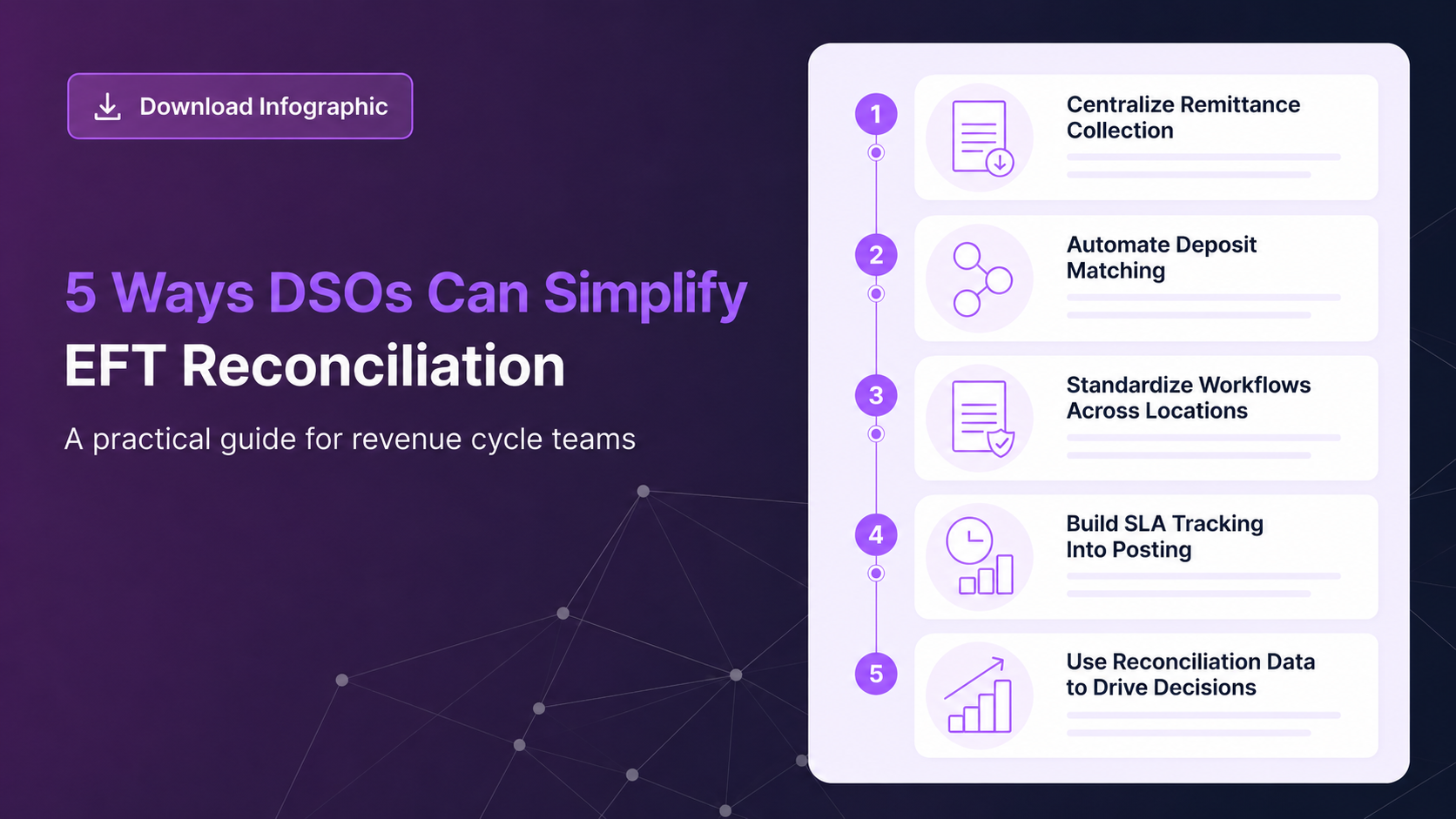
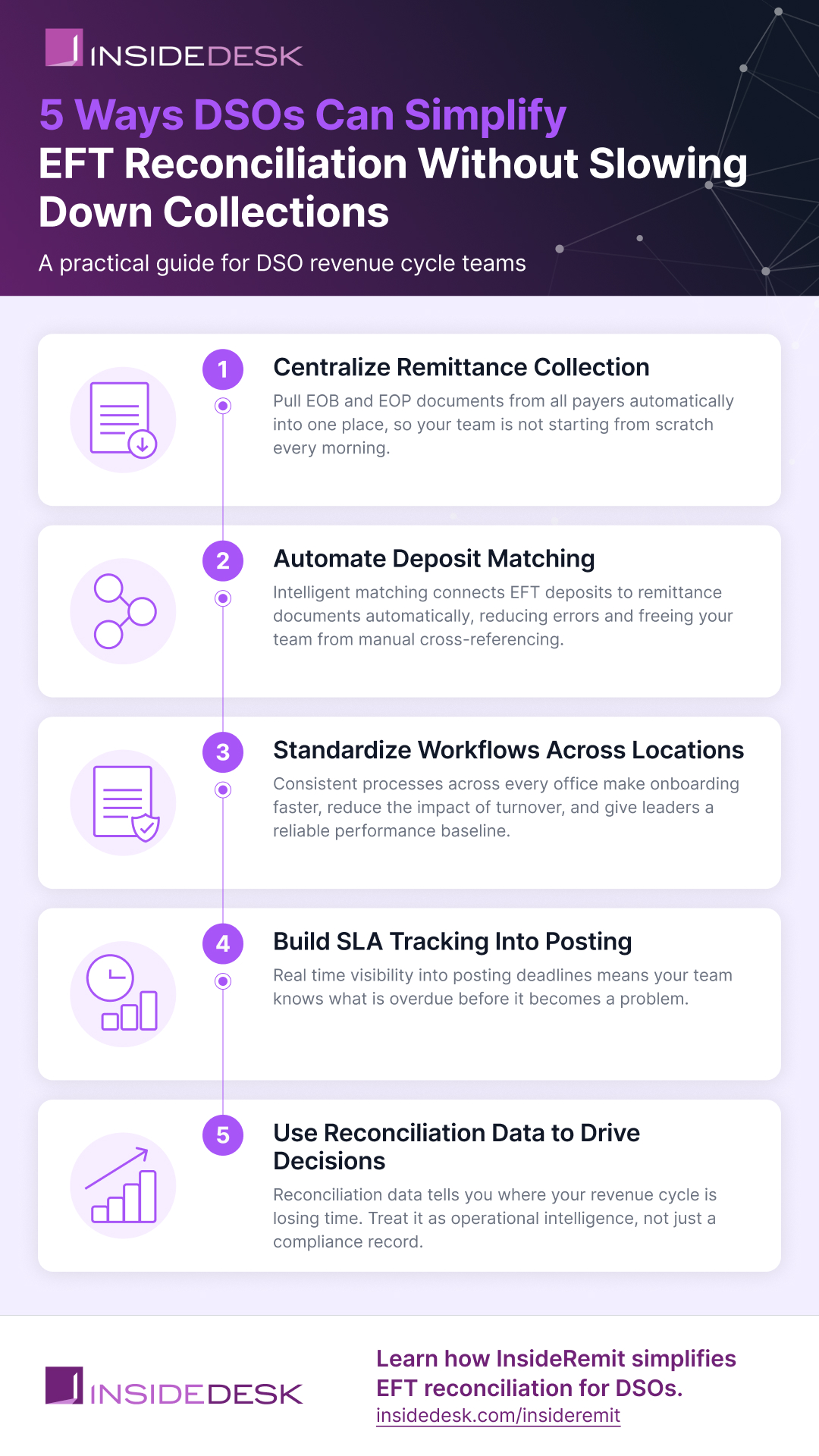
InsideRemit, InsideDesk's payment posting automation solution, is built to address this challenge directly. But whether you are evaluating automation or looking to improve your current process, here are five practical ways DSOs can simplify EFT reconciliation without sacrificing collections speed.
Why EFT Reconciliation Creates New Challenges for DSOs
When a paper explanation of benefits (EOB) arrived alongside a check, the connection between payment and remittance was built in. With EFT, that connection has to be made manually. Your team needs to locate the corresponding electronic remittance advice (ERA) or EOB document, match it to the deposit, and post it accurately to the practice management system (PMS). Across a DSO with multiple locations and dozens of active payers, each with its own portal and document format, this becomes a significant operational challenge every single day.
The volume is not the only problem. The lack of standardization across payers means your team is navigating different systems, different workflows, and different document structures simultaneously. Without a structured approach to managing this, reconciliation slows down, errors creep in, and service level agreement (SLA) targets start to slip.
1. Centralize Remittance Collection Across All Payers
One of the most impactful steps a DSO can take is moving away from portal-by-portal EOB retrieval and toward a centralized collection process. When remittance documents are pulled automatically and stored in a single location, your team is not starting from scratch every morning. Everything they need is already in one place before they begin.
This matters most at scale. The more payers and locations your DSO manages, the more time is lost to logging in, navigating, downloading, and organizing documents across disconnected systems. Centralizing remittance collection removes that friction and gives your team a consistent starting point regardless of which payer or location they are working on.
2. Automate Deposit Matching
Manual deposit matching is one of the most error-prone steps in the reconciliation process. When a team member is cross-referencing a bank deposit against a stack of remittance documents using a spreadsheet, the margin for mistakes is real. A mismatched deposit means incorrect posting, which creates reporting inconsistencies and potential compliance exposure down the line.
Intelligent matching tools can connect EFT deposits to the corresponding remittance documents automatically, flagging exceptions for human review rather than requiring staff to do the matching from scratch. This shifts your team's time from routine reconciliation work toward resolving the exceptions that actually require judgment. The result is faster posting, fewer errors, and a more defensible audit trail.
3. Standardize the Reconciliation Workflow Across Locations
A common challenge for growing DSOs is that posting workflows evolve differently at different locations. One office handles reconciliation one way, another has developed its own process over time, and a third is somewhere in between. When something goes wrong or a leader needs to step in, the lack of consistency makes it harder to diagnose and fix.
Standardizing the reconciliation workflow across all of your locations does not mean removing flexibility. It means establishing a shared process that every posting team member follows, regardless of which office they are supporting. This makes onboarding faster, reduces the impact of turnover, and gives RCM leaders a consistent baseline to measure performance against.
4. Build SLA Tracking Into Your Posting Process
Most DSOs operate with internal posting deadlines, often requiring payments to be posted within three days of receipt. The problem is that many teams do not find out they have missed a target until after the fact. By the time a delayed posting shows up in a report, the opportunity to course correct has already passed.
Building real time SLA visibility into your reconciliation process means your team knows what is overdue before it becomes a problem. Task prioritization based on deposit age and deadline proximity keeps the most time sensitive work at the top of the queue, and dashboards that surface this information for RCM leaders mean nothing falls through the cracks quietly.
5. Use Reconciliation Data to Drive Smarter Decisions
Reconciliation data is more than a compliance record. When captured consistently and accurately, it tells you a great deal about your payer relationships, your posting team's performance, and where your revenue cycle is losing time.
- Which payers are consistently slow to remit?
- Which locations are falling behind on posting deadlines?
- Which adjustments are appearing more frequently than they should?
DSO leaders who treat reconciliation data as operational intelligence rather than just a back-office record are better positioned to make staffing decisions, renegotiate payer terms, and identify process improvements before they affect collections. This requires a level of data visibility that manual processes rarely provide, but that becomes accessible when reconciliation is handled in a structured, centralized way.
EFT reconciliation does not have to be the bottleneck in your revenue cycle. The five steps above — centralizing remittance collection, automating deposit matching, standardizing workflows, building in SLA visibility, and using data more strategically — are each meaningful on their own. Together, they represent a fundamentally more efficient approach to a process that most DSO posting teams are still handling the hard way.
InsideRemit brings all of these capabilities into a single workspace, built specifically for the way DSO revenue cycle teams work. Learn more about InsideRemit to see how it addresses EFT reconciliation in practice, or request a demo at insidedesk.com/request-a-demo.