
Although the benefits of revenue cycle management in dental are clear, many DSOs, multi-group practices and private practices haven’t fixed revenue‑leaking workflows. Dental leaders focus on patient care first while revenue cycle management (RCM) gets pushed down the priority list. Billing and collections often stay the same for years, despite higher volumes and more complex payer rules.
Today, especially as payers use technology to deny more claims, ignoring your revenue cycle means losing money you’ve already earned. When insurance isn’t verified, intake details are wrong, or codes are off, claims get denied and must be reworked. The staff time spent on appeals eats into margins.
This neglect not only impacts the organization’s profit. As researchers in a recent issue of the Journal of Michigan Dental Association shared, “A mismanaged RCM process can quickly disrupt the practice’s ability to provide top-tier patient care.”
Similarly, in a recent Beckers Dental & DSO Review interview, dental practice management coaching firm NextLevel founder Gary Kadi warns, “Everyone is so focused on putting out daily fires that nobody takes the time to step back, look at data, and make a plan for the future.”
While proactive revenue cycle management does involve some time, once it’s completed, improvements build on each other. Let’s dive into the top 10 benefits of revenue cycle management in dental to help your organization reduce revenue leaks.
What is Revenue Cycle Management in Dental?
Revenue cycle management in dental is the end-to-end process that dental practices and DSOs use to oversee financial activities related to patient care. It starts at appointment scheduling and insurance verification, continues through coding and claim submission, and ends in payment posting and final collections. Inefficiencies at any step spark downstream risks to revenue.
Technology-driven dental RCM ensures all billable services are captured and reimbursed accurately and efficiently, helping practices maintain steady cash flow, minimize errors, and reduce payment delays from both insurers and patients. Diligence at every step builds a reliable financial foundation for your organization.
You don’t necessarily need AI or automation to improve your revenue cycle. Whether your processes are manual or automated, you can grow net revenue and lower collection costs if leaders commit to transparency and clear, measurable dental RCM goals.
Why Is Dental Revenue Cycle Management Important Now?
Ten years ago, dental revenue collection was simple: front desks took co‑pays. Back‑office submitted claims, posted payments, and followed up. Moreover, dental groups and DSOs relied on additional production to outrun costs. Today, with the costs of dental operations soaring, fueling revenue with more locations or providers falls short.
Even when production is strong, operating costs for practices and DSOs outpace stagnant reimbursement rates. ADA economic data shows practices face no increase in income, a fact that, when pushed up against increasing costs, creates a fiscal squeeze even when patient demand and production remain healthy.
Writers at the Dentist Entrepreneur Organization (DEO) conclude that, today, the fastest path to stabilizing margins involves disciplined cost management, payer negotiation, and operational efficiency. These three improvements are established, tracked, and measured via disciplined revenue cycle management.
At InsideDesk, we’ve seen firsthand how DSOshave simplified and accelerated collections and increased net collection rates with proactive revenue cycle management
For instance, Marquee Dental with 76 locations, reduced outstanding AR by 12% by identifying underperformers, holding offices accountable, and reallocating resources where needed. The more than $1,000,000 in “found money” they recouped can either fund growth, shore up operations, or expand into new locations.
Consider, too, Young Family Dental, a 40-location IDSO. This organization used their PMS to view and track claim success. Because it lacked advanced filtering options, Young Family Dental couldn’t prioritize claims by insurance carrier, amount expected, or age. By implementing sophisticated RCM tools, however, the organization improved visibility so it could manage and process claims far more efficiently. Within six months, they reduced outstanding AR by $565,000. They dropped AR90+ by $347,000 and overall days to collect from 44 to 24.
Today, familiarity with the benefits of revenue cycle management in dental has spurred the largest DSOs to invest significant resources into it. With many locations and a mix of processes and systems, these large organizations now rely on robust, integrated platforms to keep workflows consistent, scalable, and controlled.
While DSOs and large provider groups have embraced proactive revenue cycle management, Planet DDS’s 2025 Dental Industry Outlook shares that “the dental industry has lagged behind medical healthcare in terms of revenue cycle management (RCM) technology.” It’s time to start catching up. Knowing the benefits of revenue cycle management will fuel your efforts.
10 Benefits of Revenue Cycle Management in Dental
Most dental leaders already know their revenue cycle could be stronger, but they often underestimate how much it’s quietly leaking every month.
A carefully built revenue cycle management system plugs those leaks in these ways:
1. Increased efficiency across dental operations
Industry benchmarks from HFMA and AHIMA show that streamlining, connecting and even automating standardized RCM workflows reduces manual touches, lowers denial risk, and lets teams focus on higher-value work rather than chasing missing details. Specifically, a robust RCM system brings:
- Streamlined insurance verification and credentialing: Simple, clear steps for checking insurance and keeping credentials current help your team move faster.
- Fewer manual tasks: RCM automation speeds processes, reduces errors and gives your team more time for higher‑value tasks.
- Improved team productivity through SOPs: When your revenue cycle management involves simple, written procedures, everyone follows the same steps, no matter who is working.
2. Improved Cash Flow And Faster Payments
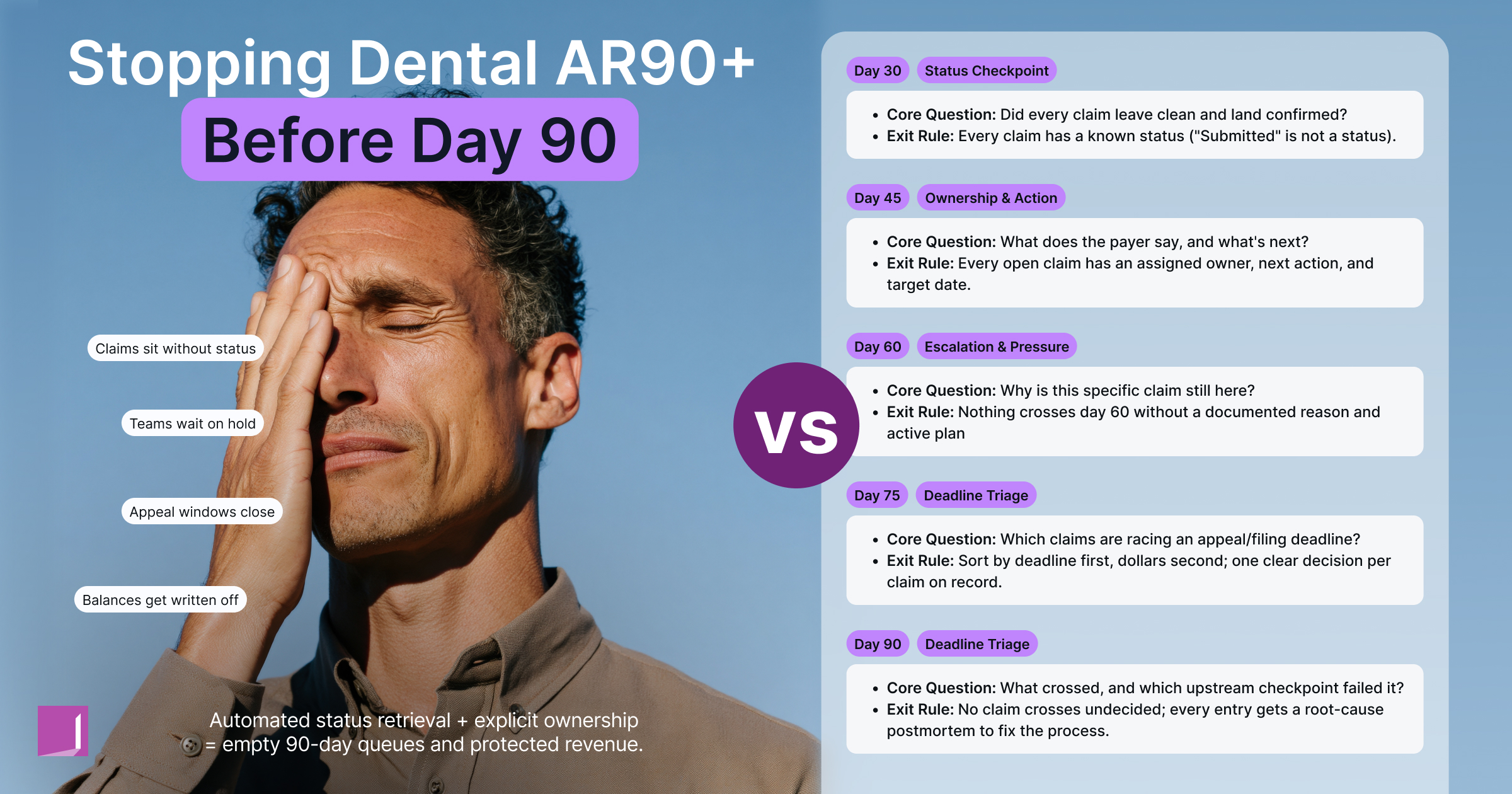
Small mistakes in coding, documentation, and benefit verification ripple downstream into denials, underpayments, and too many lagging accounts. You may struggle to reduce AR90+, an account bucket that typically recoups just 10% of the original bill. With a streamlined RCM system:
- Time between service and payment is reduced: Streamlined RCM workflows help teams submit clean claims quickly and follow up systematically. Payments arrive in days or weeks instead of months.
- Fewer claim denials and rework occur: A strong RCM process catches errors before claims go out the door.
- Patient payment collection improves: Clear financial communication, accurate estimates, and easy-to-use payment options make it more likely that patients pay their bills on time.
3. Fewer Billing Errors And Cleaner Claims
Billing errors lead to slow payer reimbursements, write‑offs, and inconsistent patient collections. Strengthening revenue cycle processes can involve:
- Automated claim scrubbing which leads to higher coding accuracy: Automated claim scrubbing tools that come along with robust revenue cycle management review claims against payer rules and coding guidelines before submission. They catch missing data, mismatched codes, and formatting errors. This oversight leads to more first-pass claims and fewer denials
- Real-time eligibility checks: The real-time eligibility verification involved in RCM automation confirms coverage, benefits, and limitations while the patient is still in the office.
- Reduced human error in patient billing: When staff can rely on automated calculations and clear prompts, patients receive accurate, easy-to-understand bills.
4. Stronger Insurance Reconciliation And Fewer Missing Dollar Issues
When insurance payments, ERAs/EOBs, and PMS postings are tightly reconciled, it becomes much easier to spot underpayments, missing claims, and incorrect adjustments before they erode margins. Consistent, automated reconciliation creates an early‑warning system for revenue leakage.
With a stronger reconciliation process, you achieve:
- Faster follow‑up on payer errors: Discrepancies between expected and actual payments surface quickly, so teams can appeal underpayments or request reprocessing before filing limits run out.
- Cleaner patient balances: When insurance is posted accurately the first time, patient statements reflect the true remaining responsibility, reducing confusion, and refunds.
- Less money “stuck”: Standard workflows for unmatched deposits and ERAs keep dollars from sitting in limbo, so more revenue reaches the right provider, location, and ledger without manual detective work.
5. More Predictable Revenue And Forecasting
When posting and follow-up are consistent, your numbers stop swinging wildly from month to month, and cash flow becomes far easier to anticipate. With reliable, timely data, leadership can trust reports and plan staffing, growth, and budgets in a way that wins buy-in.
6. Improved Patient Experience
A carefully calibrated revenue cycle helps to generate accurate estimates and clear statements. Patients understand exactly what they owe and why, which builds trust and reduces billing disputes.
For example, instead of handing a patient a vague “balance due” bill weeks after treatment, your team can use RCM tools to verify benefits and patient payment responsibility up front, provide a written estimate that breaks down insurance versus out‑of‑pocket costs, and follow it with a clear, itemized statement. Patients know what to expect financially, are less likely to feel surprised or misled, and are more willing to pay promptly.
7. Less Staff Burnout And Lower Turnover In Billing Teams
With staffing shortages across the dental industry, simplifying the workload and removing friction is essential. You want to protect your people from burnout and keep your best billers from walking out the door.
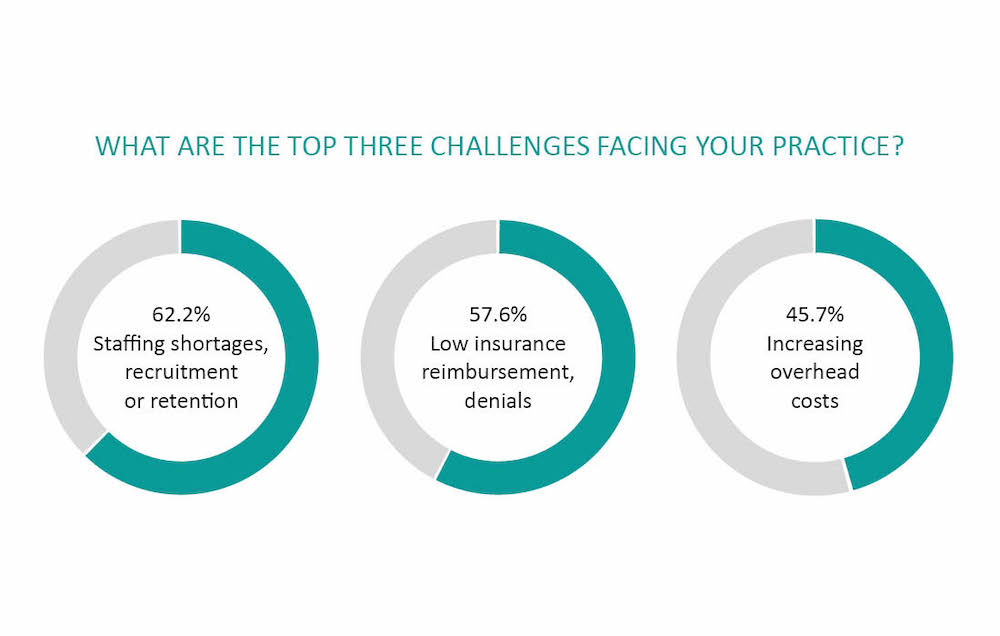
With RCM automation, fewer manual steps and fewer exceptions mean billing teams aren’t constantly keying data, fixing avoidable errors, or hunting for missing information. Staff day-to-day work becomes more sustainable.
8. Better Compliance And Audit Readiness
The incomplete documentation, inconsistent adjustments, and opaque write-offs that come with neglected RCM can raise red flags if a payer or regulator takes a closer look. Tightening your revenue cycle processes now helps protect the practice.
The clean documentation, consistent adjustments, and traceable posting involved in a proactive revenue cycle management system make it easy to show exactly what was billed, what was paid, and why any changes were made. When every dollar has a clear, defensible paper trail, compliance issues diminish.
9. Actionable Insights To Improve Business Performance
Without visibility into denials, aging, and write-offs, dental organization leaders can’t see where revenue is slipping away, let alone which levers to pull to fix it.
Reliable RCM metrics generated by proactive RCM systems show you exactly where money is leaking out of the business. Instead of reacting to slow cash flow in general, you can pinpoint and fix specific issues. When you surface payers underpaying a code or a location with chronic documentation errors, you take a critical first step: identifying the problem.
10. Operational Scalability For DSOs
Many DSOs hit a growth ceiling not because their operations don’t scale cleanly as they add locations. Each new practice brings its own way of scheduling, verifying insurance, and billing, creating friction, errors, and overhead instead of synergy.
Standardized processes across locations enable shared services because every office follows the same playbook for scheduling, verification, billing, and collections. That consistency makes it much easier to centralize RCM functions, roll out new tools, and compare performance across sites.
Easier onboarding of new practices comes from having clear, repeatable RCM procedures, training materials, and technology already in place.
InsideDesk Optimizes Your Revenue Cycle Management
Efficient RCM not only gets you paid faster and more reliably, it also impresses the partners you depend on for growth. Bankers, investors, and partners with growth capital all want to see an efficient, even modernized, revenue cycle.
In a recent post, Grant Thornton explains, “Investor focus in Revenue Cycle Management and Healthcare Information Technology is shifting toward scalable, efficiency-driven solutions.” The benefits of revenue cycle management in dental outlined above show that your organization can improve margins, operational efficiency, workflows, and staff satisfaction.
InsideDesk helps dental organizations improve key financial metrics, including collections, profit margins, and EBITDA. Our revenue cycle management platform turns raw data into actionable insights.
Schedule a demo to see how InsideDesk can help your DSO or dental group build a robust revenue cycle system that plugs revenue leaks and recoups maximum reimbursements.