
We recently wrote about the qualities private equity firms look for in DSO targets [Link when available]. If your DSO can provide either great value, a lucrative specialty, or AI and automation-forward technology across your portfolio, you could be a prime candidate for investment from or acquisition by a PE firm looking for just those characteristics.
While a distinct DSO type can help you position yourself, PE firms ultimately look most closely at your quality of revenue (QoR). This is an analysis of how reliably and sustainably your DSO generates revenue. It looks into what’s driving the top line, growing predictability, and whether any accounting changes are inflating returns.
Think of quality of revenue as your proof. It shows buyers that the revenue accounted for makes it into your bank account. PE firms need to determine the multiple, trajectory, and reliability of your revenue stream. If you want top-tier valuations, focus on building rock-solid, predictable revenue.
With the guidance in this post, your organization can establish and demonstrate a robust quality of revenue.
1. Revenue Cycle Management Efficiency
RCM efficiency and optimization dictate proactive policies and technology for claim submission, follow-up, and denial management. It often takes AI-supported, automated digital tools to gauge how rapidly and reliably claims are processed and paid.
Evidence of proactive revenue cycle management also demonstrates to investors your ability to maximize collections, minimize leakage, and sustain reliable cash flow. They want to see that your organization converts billed production into actual revenue in a timely, transparent way, with minimal write-offs.
Revenue cycle management is the engine that transforms clinical activity into collectible revenue.
What PE wants to see in revenue cycle management:
- Automated processes for steps in the revenue cycle.
- Technology that reduces reliance on manual work and minimizes errors.
- Integration of revenue cycle management (RCM) platforms with PMS, billing systems, and payer portals.
- High clean claim rates with a low percentage of denied or delayed claims, all tracked with real-time KPIs and dashboards.
- Swift resolution protocols for denials, rejections, and underpayments.
- Clear accountability within the organization: defined roles, escalation processes, and performance incentives tied to collection targets and AR reduction.
- Regular reporting and benchmarking of RCM efficiency across all locations..
- Commitment to ongoing improvement, such as investment in new RCM technology, employee training, and routine process audits.
Show investors you’re using smart technology and streamlined processes to keep money flowing.
Pitfalls PE Looks For
- Manual or outdated workflows that cause claims denial backlogs or slow reimbursement cycles.
- Lack of automation leading to labor cost inflation and missed productivity gains.
For example, PE investments in dental RCM SaaS fail when PE firms realize too late that legacy systems can’t support scale. They don’t want to end up with high post-close IT upgrade costs.
2. AR Aging
This element of quality of revenue assesses the time it takes to convert billed revenue into collected cash (AR aging). It analyzes uncollected or overdue amounts to identify revenue leakage or systemic bottlenecks.
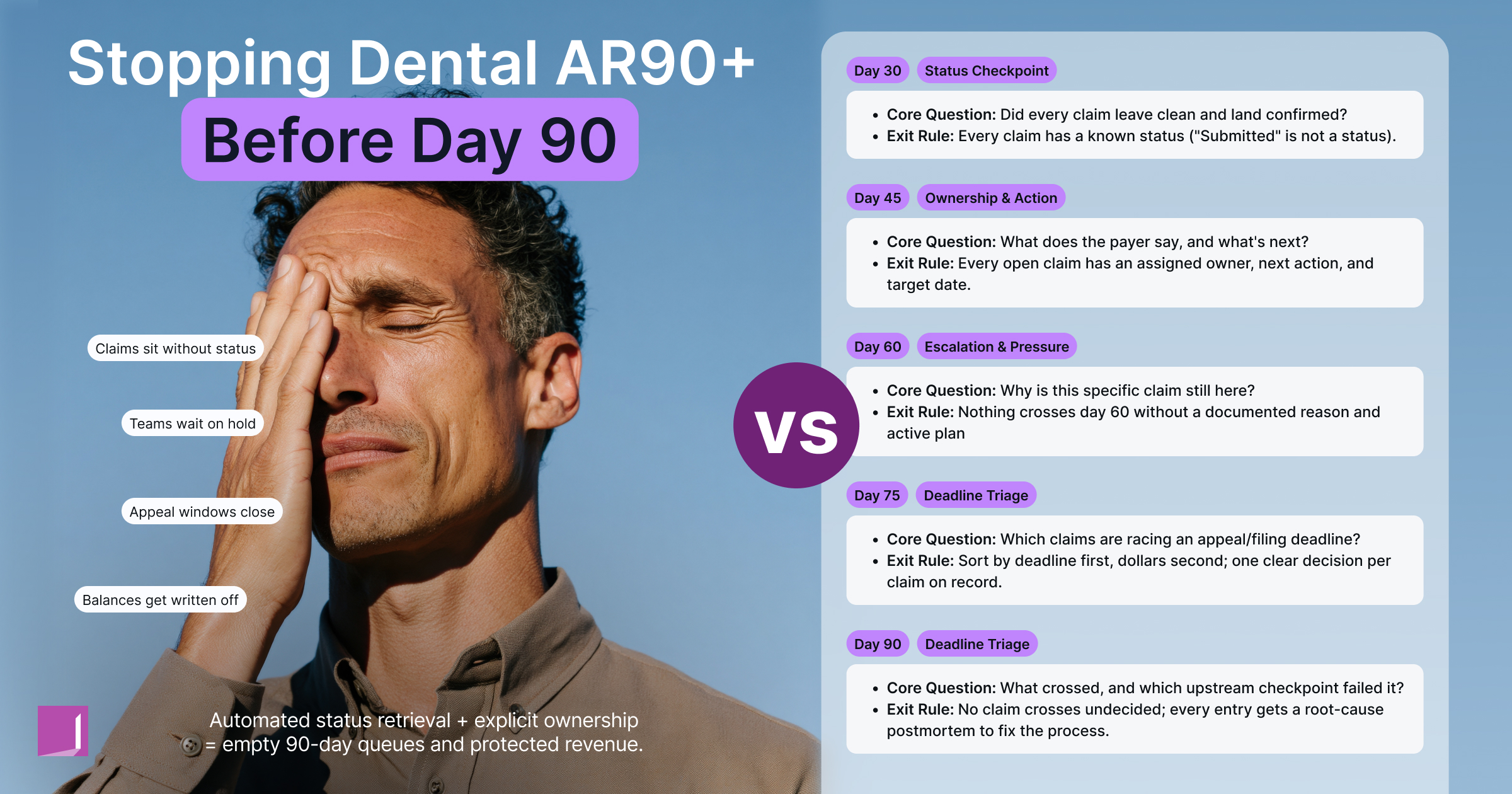
Unfortunately, clients who come to us typically have 35% of their AR in the 90-day bucket, as we cover in this webinar. You can reduce AR90+ with the effective strategies detailed in Reducing AR90+: What Every Dental Leader Should Know.
What PE Wants to See in AR Aging
- Accounts receivable that consistently turn over quickly, with most balances collected within industry benchmarks.
- A low percentage of receivables in the 60+ or 90+ day aging buckets.
- Transparent, real-time AR reporting, ideally through automated claims management systems.
- Tight internal controls and workflows to identify and resolve AR issues early.
- A strong history of resolving denied claims promptly and efficiently.
- Clearly documented policies for handling patient balances, financial hardship cases, and escalating collection efforts.
- Management intervention and improvement plans for any AR “hot spots”—such as particular payers, services, or locations showing lagging collections.
These factors assure private equity firms that revenue is not just being recorded on paper but is efficiently converted into cash. They want to see minimal risk of loss and signs of sustainable, reliable financial management.
Pitfalls PE Looks For
- A high percentage of revenue stuck in old AR buckets (>90 days), indicating poor collection processes.
- High write-off ratios for uncollected claims.
As an example, a DSO group with 12 offices struggles with slow collections and consistently has 30% of its accounts receivable languishing in the 90+ day bucket. After the acquisition, the private equity sponsor looks to drop AR aged over 90 days and reduce write-offs. This improvement is expected to boost EBITDA, enabling reinvestment in growth.
3. Revenue Source Analysis
This quality of revenue factor examines revenues by payer, location, provider, and service type to reveal concentration risk.
Factors PE Wants To See In Revenue Source Analysis
- A well-diversified payer mix minimizing overreliance on any single source.
- Geographic diversity across multiple regions or states.
- Stable and growing service mix, indicating adaptability to patient needs and market trends.
- Transparent, verifiable billing and collections data that matches bank deposits and remittance reports.
- Low incidence of write-offs or denied claims.
- Clear documentation of contracts and reimbursement terms, reflecting proactive payer negotiation and management.
These factors assure private equity firms that the revenue base is resilient, sustainable, and scalable.
Pitfalls PE Looks For
- Overreliance on a handful of payers.
- Dependence on one type of patient or a single region. If a payer contract changes or local policy shifts, your revenue could take a sudden hit.
For example, a DSO with eight offices in one location relies on just three managed care contracts accounting for 80% of practice revenue. When one large contract is abruptly reduced, practice collections drop by 30% in a quarter, forcing layoffs and rapid location closures. The lack of revenue diversity exposes the business to destabilizing financial threats—a key concern for PE investors and a warning sign that further diligence and risk mitigation are required.
4. Contractual Allowance
Contractual allowance adjusts gross revenue to reflect actual allowable amounts, factoring in insurance write-offs, reimbursements, and discrepancies between billed and collected amounts.
What PE Wants to See in Contractual Allowance Analysis
- Transparent and consistently applied contractual allowance adjustments that accurately reflect the difference between gross charges and revenues collectible under payer contracts.
- A documented system for tracking and reporting these adjustments, with clear reconciliation in financial statements, so true net revenue is never overstated.
- Contract terms with payers that are close to standards and prices set in your market.
- Minimal unexpected adjustments or manual overrides.
- Clear documentation of the methodology used to estimate contractual allowances (and bad debt allowances, separately).
Pitfalls PE Looks For
- Contracts where gross revenue appears high but allowable/collected amounts are low due to aggressive payer write-offs.
- High variance between billed and collected amounts signals poor contract negotiation or payer leverage.
As an example, DSOs experiencing ongoing revenue erosion face post-deal write-downs and missed profitability targets.
5. Charge Capture and Coding Audit
Accuracy of coding and charge capture ensures eligible services are billed correctly.
What PE Wants To See In Charge Capture and Coding Audits
- Clean claim rates that meet or exceed industry norms.
- A robust charge capture process.
- Proactive auditing protocols (preferably by a credible third-party firm) to identify and quickly correct coding errors or documentation lapses.
- Transparency in reporting, shown by audit trails and management documentation.
Investors want to know your reported revenue is real—no surprises, no audit risks, and nothing that could hurt your reputation later. A DSO’s reported revenue truly reflects care provided.
Pitfalls PE Looks For
- Missed charges due to poor coding processes, resulting in underbilling and lost revenue.
- Coding errors leading to denials, audits, or even fraud claims.
6. Patient Acquisition and Retention Metrics
This element of quality of revenue measures new patient acquisition costs, patient retention rates, and average revenue per visit. They are key predictors of future growth.
What PE Wants To See In Patient Acquisition And Retention Metrics
- Clear, upward-trending new patient acquisition rates.
- High patient retention percentages.
- Comprehensive tracking of referral sources.
- Favorable patient lifetime value (PLV) and patient churn rates.
- Ability to analyze acquisition and retention by location, provider, payer type, or demographic.
- Proactive management engagement in monitoring KPIs and executing campaigns or service enhancements.
These metrics help assure private equity that a dental group’s revenue is not only growing, but also stickier and repeatable. This is crucial for long-term valuation and attractive, risk-adjusted returns.
Pitfalls PE Looks For
- High spend on new patient acquisition cost (NPAC). If you’re spending a lot to bring in new patients but can’t keep them coming back, that’s a warning sign for investors.
- Low retention rates indicating dissatisfaction or poor service quality.
For example, a DSO that invested heavily in marketing but saw high patient churn may raise PE suspicions. PE can be concerned that it may end up conducting portfolio write-downs due to low lifetime value.
7. Operational and Technology Impact
This factor assesses the role of technology, digital workflows, and automation in improving billing accuracy, accelerating collections, and supporting sustained revenue quality.
What PE Wants To See In Operations and Technology
- Cloud-based management platforms and system integrations that support scalability, centralize data, and eliminate redundant manual tasks.
- Real-time performance dashboards and advanced RCM analytics for financial, clinical, and operational KPIs.
- Effective use of automation that reduces administrative overhead.
- Consistent application of technology across all locations. Signs that standardized processes and compliance will remain as the DSO expands.
- Demonstrated return on technology investments, such as improved clean claim rates, faster cash conversion, higher patient retention, or increased provider productivity.
These factors tell buyers that the DSO is already leveraging technology and process excellence for sustainable, profitable growth and reliable integration.
Pitfalls PE Looks For
- Technology gaps that cause billing errors, denied claims, and staff inefficiency.
- Failure to integrate practice management, RCM, and EHR systems after acquisition, leading to cost overruns.
For example, DSO acquisitions with fragmented tech stacks require costly post-close conversions, hurting PE returns and delaying expected integration synergies.
Prove Your Quality of Revenue with InsideDesk
InsideDesk is your centralized hub for claims and payer A/R, built for DSOs who want cleaner cycles, tighter follow-up, and real visibility. Automate payer follow-up, track denials, and get the analytics RCM and finance leaders need to cut aging and forecast cash with confidence.
What you’ll run on InsideDesk:
- Centralized claim oversight: Submission through status, with prioritized worklists and SLAs so stalled claims get actioned before they drift to 60+/90+.
- Denial tracking & rework: Root-cause analysis by payer, plan, code, location and provider; standardized queues and templates to improve overturn rates.
- Payer A/R analytics that matter: First-pass yield, denial rate, payer turnaround, aging by payer/plan/service line, and variance hot spots—standardized across locations.
- Team productivity & scorecards: See who’s moving claims, which payers are slowing cash, and where to focus to reduce AR90+
Schedule a demo today to discover how InsideDesk can help your DSO optimize your revenue cycle to reduce AR risk.