Every processed dental claim generates a remittance that explains what the payer paid, what it adjusted, and what the patient owes. That explanation arrives in one of two forms: an explanation of benefits (EOB) or an electronic remittance advice (ERA). Because both carry the same information, billing teams often treat the terms as interchangeable. The format, however, decides whether a payment posts itself in minutes or sits in a portal waiting for someone to find it, key it in, and reconcile it by hand. Here is the difference in plain terms, and why it shapes your entire posting workflow.
What is an EOB (explanation of benefits)?
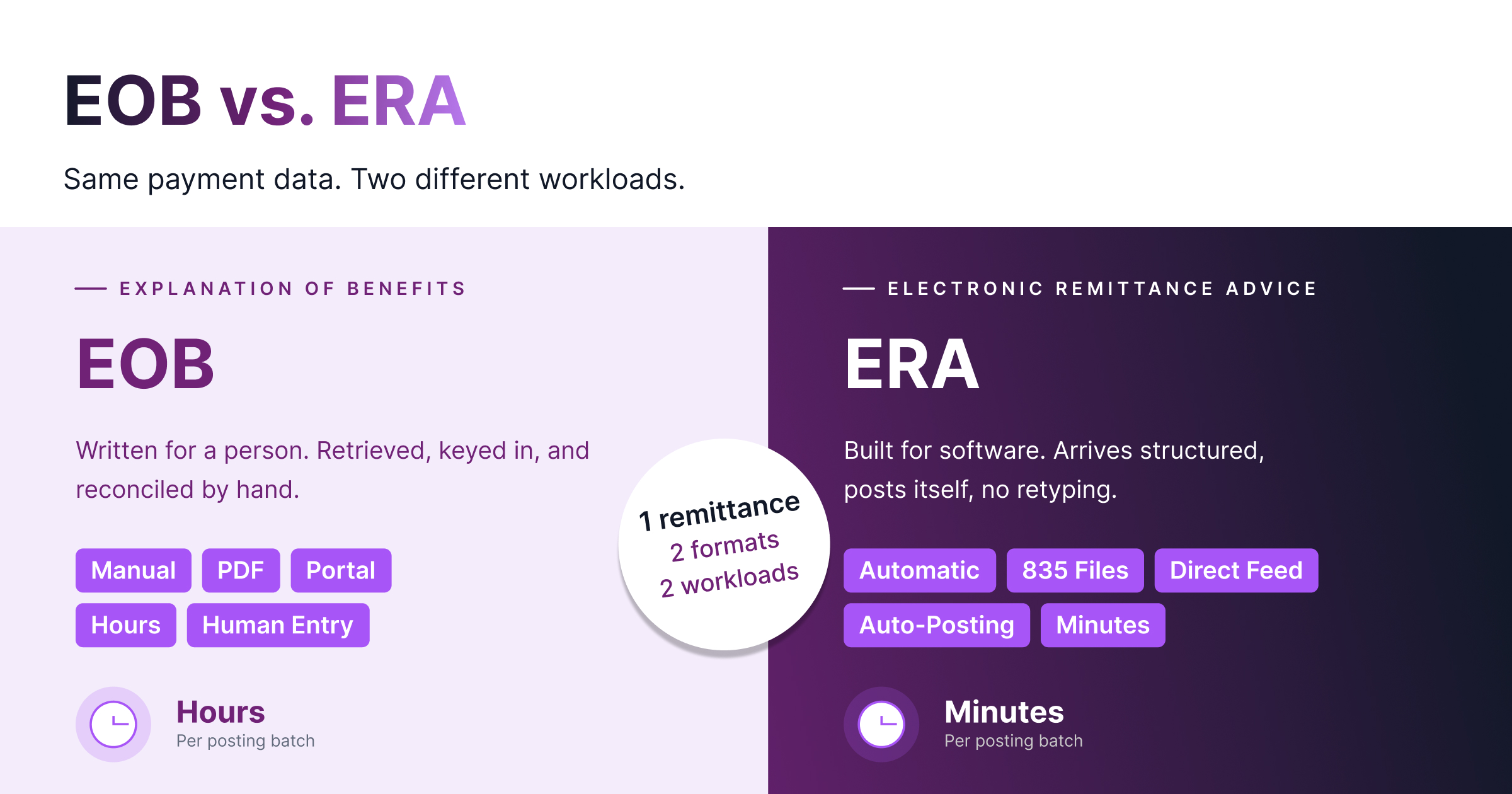
An EOB is a human-readable statement the payer sends after processing a claim. It shows each procedure billed, the amount the payer allowed, contractual adjustments, the amount paid, the patient’s remaining responsibility, and any denial or adjustment codes. EOBs arrive as paper mail, faxes, PDFs, or downloads inside payer portals, and both the practice and the patient typically receive a copy.
Because an EOB is written for a person, a person has to handle it. Someone retrieves it, interprets each line, keys the detail into the practice management system (PMS), and matches the payment to a deposit. Each touch takes staff time, and each retyped number is a chance for a transcription error to slip into your accounts receivable.
What is an ERA (electronic remittance advice)?
An ERA carries the same remittance detail in a machine-readable format. Technically it is the HIPAA-standard 835 transaction, a structured data file delivered through a clearinghouse directly into your PMS or posting software. Because the data arrives structured, the system can post payments and adjustments automatically, line by line, with no retyping.
ERAs usually travel with electronic funds transfer (EFT), the direct-deposit half of the pair. The EFT delivers the money and the ERA explains it, which lets software match remittances to bank deposits without anyone shuffling paper.
EOB vs. ERA at a glance
Why the difference matters for dental billing
On paper this looks like a simple format distinction. In practice, the share of your remittances that arrive as EOBs quietly sets your posting speed, your error rate, and how your team spends its day. Four places where it shows up:
- Posting speed. An ERA can post the moment it lands, while an EOB waits for retrieval and manual entry. Groups working toward a Day+3 posting SLA usually find that the manual EOB pile, and only rarely the ERA feed, is what puts the target at risk.
- Accuracy. Manual keying introduces transposed digits, misapplied adjustments, and payments posted to the wrong claim. Each small error distorts AR aging and production-to-collection reports, so leadership ends up making decisions on numbers the team quietly knows are soft.
- Retrieval burden. ERAs show up on their own. EOBs have to be hunted down across dozens of payer portals, each with its own login, layout, and session timeout. For a multi-location group, that hunt alone can consume hours of skilled biller time every single day.
- Reconciliation. Tying payments to bank deposits is straightforward when an ERA pairs with its EFT and the software matches them. With EOBs, someone reconciles remits against deposits by hand, which is where unapplied cash and month-end mysteries tend to originate.
The catch: dental payers still send plenty of EOBs
If every payer delivered ERAs, this article would end here. Dental lags medical in electronic remittance adoption, and the gap is stubborn. Some smaller dental payers and plan administrators simply do not offer 835 files. Others require ERA enrollment payer by payer, and often location by location, so a growing DSO faces a fresh stack of enrollment paperwork with every acquisition.
The result is a hybrid reality: even groups fully committed to electronic remittance still receive a steady stream of portal downloads and paper EOBs. Your posting workflow ends up only as fast as its slowest format, which is why the EOB share of your remittance mix deserves more attention than it usually gets.
How DSOs close the gap
The groups that post fastest stop treating EOBs and ERAs as two separate workflows. They automate the retrieval of EOBs from payer portals, convert them into postable data, and run everything through a single posting and reconciliation process regardless of how the payer chose to send it.
This is the problem InsideRemit was built for. It automates EOB collection across payer portals and posts payments with AI-driven EFT matching, so remittances reconcile quickly and accurately whether they arrived as a structured 835 file or a PDF buried in a portal. Your team keeps one workflow, and the payer’s format choice stops dictating your posting speed.
EOB vs. ERA: frequently asked questions
Is an ERA the same as an EOB?
They report the same claim outcome in different formats. An EOB is a document written for people to read, while an ERA is a structured data file (the 835 transaction) built for software to post automatically.
Do I still need the EOB if I receive an ERA?
For posting purposes the ERA contains everything you need. Many teams keep EOBs on hand for appeals, patient questions, and audits, since the document format is easier to share and read.
What is an 835 file?
The 835 is the HIPAA-standard electronic transaction for healthcare payment and remittance advice. When someone in dental billing says ERA, they are referring to an 835 file.
How long should a dental office keep EOBs?
Most practices retain remittance records for at least seven years to cover payer audit windows and state retention rules. Requirements vary by state and payer contract, so confirm against your own obligations.
Can every dental payer send ERAs?
No. Many dental payers offer them, usually with per-payer enrollment, but a meaningful share still deliver remittances only as paper or portal EOBs. Most dental groups operate with a mix of both.
EOB and ERA describe the same moment in the revenue cycle, the payer telling you how a claim was settled. What separates them is everything that has to happen next. Knowing your remittance mix, and building one workflow that handles both formats, is one of the simplest ways to speed up posting, tighten reconciliation, and give your billers their day back.
Want to see what automated EOB retrieval and posting looks like across your locations? See InsideRemit in action.